

Alberta’s Spray Foam Insulation Experts — Open Cell & Closed Cell
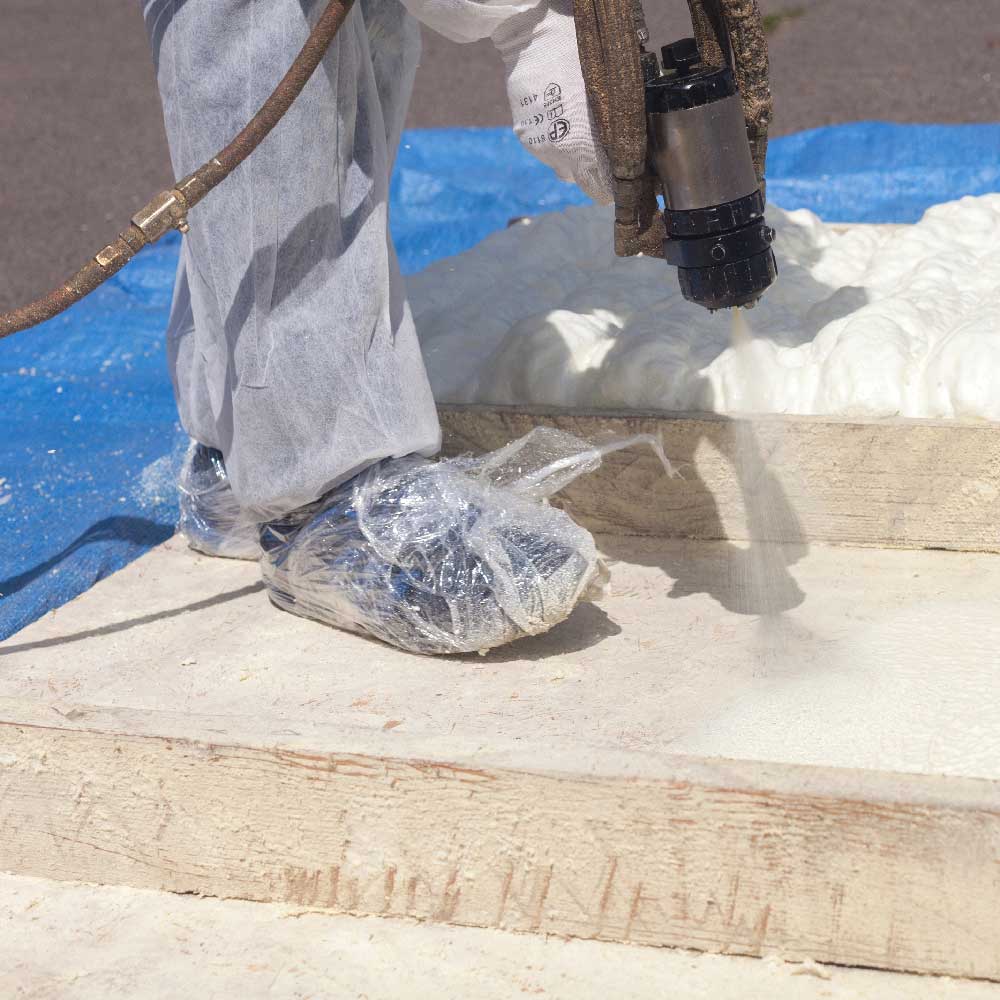
Spray foam has rapidly become the preferred insulation solution for spaces that traditional products can’t properly address — rim joists, frost walls, vaulted ceilings, crawl spaces, areas with vapour barrier issues, and anywhere airtight performance matters as much as thermal resistance. At IDEAL, we install both types of spray foam: open cell (half-pound) and closed cell (two-pound), and we’ll recommend the right product based on the specific demands of your application, not on what’s most convenient for us to install.
We also work extensively on attic vapour barrier remediation using closed cell spray foam — a solution that’s become increasingly common in Calgary and Edmonton as older homes reveal inadequate or failed poly installations. A minimum 2″ layer of 2lb closed cell foam on the attic floor seals all penetrations and delivers a vapour barrier that exceeds current Alberta Building Code standards, without requiring drywall removal.
Why Choose IDEAL for Spray Foam Insulation?
Spray foam is the most technically demanding insulation product to install correctly. Improper application — wrong thickness, wrong substrate preparation, incorrect product for the application — leads to delamination, air gaps, moisture problems, and wasted money. With over 44 years in the insulation industry and deep experience in both open and closed cell products, IDEAL has the expertise to get it right the first time.
Open Cell vs. Closed Cell Spray Foam — Which Is Right for Your Project?
Spray foam comes in two distinct formulations, each with different properties, applications, and price points. Understanding the difference is the first step to making the right choice for your home.
Open Cell Spray Foam (Half-Pound)
Open cell spray foam expands to approximately 100 times its liquid volume, making it ideal for filling tight, irregular, or hard-to-reach spaces where access is limited. It provides excellent air sealing and sound dampening, and its lower cost makes it well-suited for applications where vapour control is handled separately.
Common applications include:
Note: Open cell foam is not a vapour barrier. In Alberta’s climate, it should not be used as the sole insulation solution in exterior walls or attic spaces where vapour control is required.
Closed Cell Spray Foam (Two-Pound)
Closed cell spray foam offers the highest R-value per inch of any insulation product — approximately R-6.5 to R-7 per inch — and cures to a hard, rigid finish that adds structural strength to wall assemblies. Its greatest advantage in Alberta’s climate is its dual function as both a thermal insulator and a vapour barrier, achieving less than 60 ng/Pa vapour permeance at just 2″ of thickness.
This makes it the product of choice for:
Closed cell foam also adds significant shear strength to wall assemblies — a real structural benefit, not just a marketing claim. In 2×4 wall cavities, closed cell foam increases shear strength by up to 300%, making the building envelope more rigid and resilient.
Is Spray Foam the Right Solution for Your Home?
Spray foam isn’t always the answer — but for certain problems and certain spaces, nothing else comes close.
Here are the situations where we most commonly recommend spray foam over other insulation types:
Spray Foam Installation Process & Safety
Spray foam is the most technically involved insulation product we install. Proper preparation is essential to a successful outcome. Here’s what to expect before, during, and after your installation.
Before Your Installation
During & After Your Installation
Questions about the process or safety requirements? Call us before you book. We’d rather answer every question upfront than have a customer catch a surprise on installation day.
WE DON’T HAVE TO TELL YOU HOW GOOD WE ARE, OUR CUSTOMERS DO THAT FOR US.
“IDEAL came out to spray foam our rim joists and the attic floor where we had a vapour barrier issue. The estimator was incredibly knowledgeable — he explained exactly what was happening with the old poly and why the 2lb foam was the right fix. The crew was in and out quickly, everything was clean, and the improvement in the house that first winter was obvious. Worth every penny.”
Robert K.
Google Review — Spray Foam / Vapour Barrier Remediation, Calgary
“We had spray foam done on our entire garage and the crawl space under the addition. IDEAL was professional throughout. They were upfront about the 24-hour vacate requirement and made sure we understood exactly what was happening and why. The crawl space used to be brutally cold in January. Not anymore.”
Diane & Tom F.
Google Review — Garage & Crawl Space Spray Foam, Edmonton
“As a builder, I need an insulation crew I can count on to show up, do the job right, and not create problems for my trades coming in behind them. IDEAL has been that crew for us on multiple projects. Their spray foam work in particular is clean and precise. I recommend them without hesitation.”
Greg H.
Google Review — New Construction Spray Foam, Calgary
Attic Insulation — Frequently Asked Questions
Open cell (half-pound) foam expands to roughly 100 times its liquid volume, is softer and more flexible when cured, and provides good air sealing and sound dampening. It does not act as a vapour barrier. Closed cell (two-pound) foam is denser, cures hard and rigid, has a significantly higher R-value per inch (~R-6.5 to R-7 vs ~R-3.5 for open cell), and at 2″ or more, functions as a code-compliant vapour barrier. The right choice depends on your specific application — we’ll advise you during your free estimate.
During curing, spray foam releases chemical off-gases that are not safe to breathe in an enclosed space. This is a standard health and safety requirement for all residential spray foam installations in Canada — not specific to IDEAL or any particular product. The 24-hour window allows the foam to fully cure and the space to air out. We’ll provide you with a waiver that explains this requirement, and we’ll discuss it with you before booking so you can plan accordingly.
Yes. Alberta Building Code requires that spray foam insulation in occupied spaces be covered with an approved thermal barrier — typically 1/2″ drywall — or an approved thermal coating product such as Hibar or DC315. This is a fire safety requirement. If your project includes drywall finishing, this will be handled as part of that scope. If not, we’ll discuss approved coating options with you.
Yes — and it’s often the most practical solution. If your attic poly was installed inadequately or has degraded over time, adding new insulation over the top won’t fix the underlying vapour barrier deficiency. Applying a minimum 2″ layer of 2lb closed cell spray foam to the attic floor seals all penetrations and provides a vapour barrier that meets or exceeds current building code standards — all without removing your drywall or ceiling. This approach is increasingly common in Calgary and Edmonton as older homes come up for renovation.
The safety concerns you may have read about relate primarily to improperly mixed or incorrectly installed spray foam, and to occupancy during or immediately after application. When installed by trained and certified crews using quality products — and when the 24-hour vacate protocol is followed — spray foam is a safe, durable, and well-established insulation product. IDEAL uses only products that meet Canadian safety standards, and our crews follow all required protocols on every job.
Absolutely. Spray foam is one of the most effective solutions for garages, workshops, quonsets, and metal buildings. It adheres directly to metal, wood, concrete, and most clean dry surfaces without requiring framing. For attached garages, it also provides an excellent air barrier between the garage and the living space, reducing exhaust fume infiltration and improving energy efficiency.
In a standard 2×4 wall cavity, fibreglass batts deliver approximately R-13 to R-15. Closed cell spray foam in the same cavity achieves R-20 to R-24, with the added benefit of air sealing and vapour control built in. For new construction or major renovation projects where wall performance is a priority, the performance difference is significant. The tradeoff is cost — spray foam is more expensive per square foot — but many homeowners find the long-term energy savings and elimination of air leakage makes it worthwhile.
Yes. IDEAL is an approved contractor under the Clean Energy Improvement Program (CEIP), which allows eligible Alberta homeowners to finance energy efficiency upgrades — including spray foam insulation — at competitive rates, with repayment through their property tax bill. No large upfront payment required. Ask us about CEIP eligibility when you call for your free estimate.