
Calgary Blown-In Insulation — Fiberglass and Cellulose
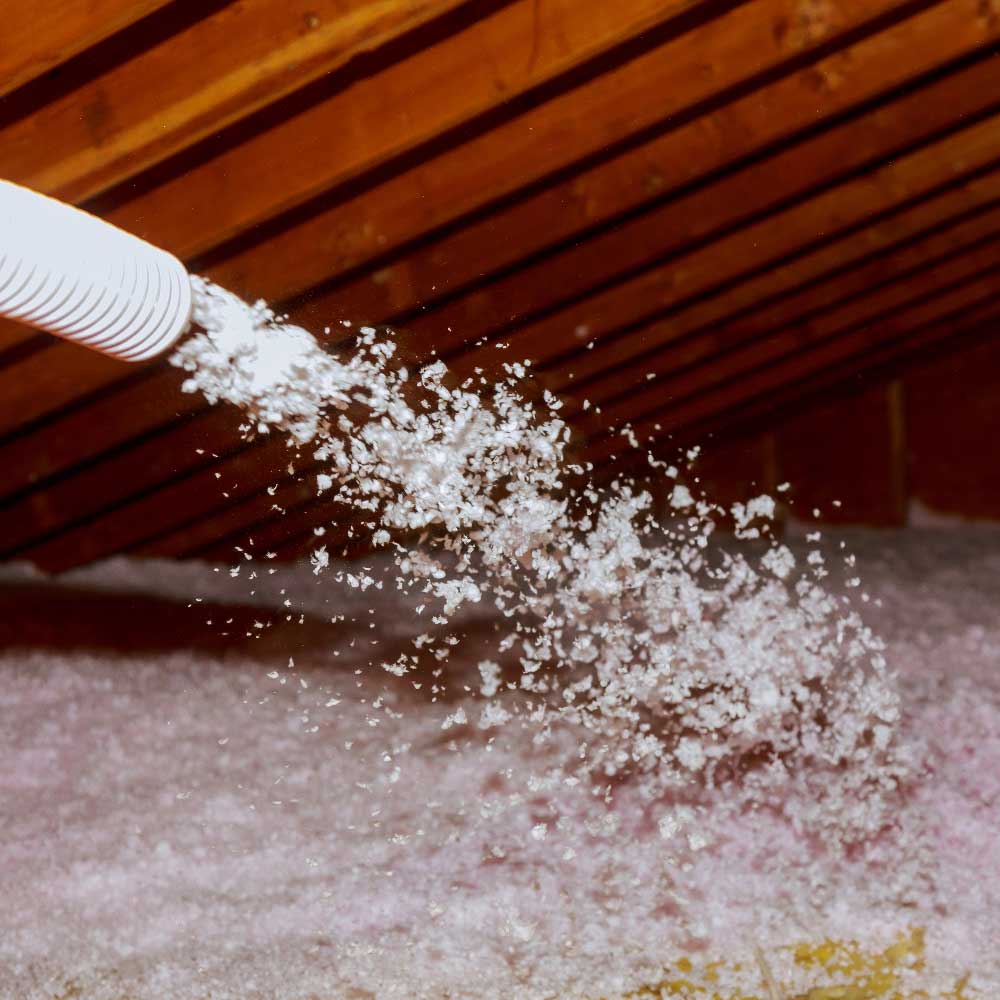
Blown-in insulation, also called loose-fill insulation, which is installed by machine rather than by hand. Loose fibres are propelled into the attic space and settle around joists, blocking, wiring, and other obstructions to create continuous, uniform coverage. Unlike pre-cut batt panels, which have to be fitted around every irregularity and can leave gaps at the edges, blown-in fills in all directions and gets into areas that batts typically miss.
We install two blown-in products: blown-in fiberglass, which is our standard attic recommendation for most projects in Calgary and Edmonton, and blown-in cellulose for clients who specifically want a recycled-paper product. We also install BIBS (Blown-In Blanket System) for open wall and ceiling cavities in new construction. This is a different application with a different installation process.
Every blown-in project starts with an assessment. We measure the existing R-value, inspect the vapour barrier, check ventilation, and look at air sealing gaps around pot lights and penetrations before recommending a scope. In many cases, the job is straightforward: existing insulation is in reasonable condition, the vapour barrier is intact, and we blow new fiberglass directly over the top. Where there are complications, we explain them clearly and quote the full scope before we start.
Why Choose IDEAL for Blown-In Insulation?
Blown-in insulation is a fast job when everything goes smoothly, and that speed is part of what makes it cost-effective. But what happens before and after the blowing matters as much as the product itself. An attic that isn’t properly assessed before the job can end up with new insulation over existing moisture problems, or a vapour barrier deficiency that the new material just buries. What happens after matters too: a crew that doesn’t install baffles at the eaves, or skips air sealing around the pot lights, leaves performance on the table regardless of how much insulation went in.
Blown-In Insulation Products — Which Is Right for Your Project?
Not all blown-in products are the same. Here’s how our two options compare, and where each one is the right call.
Blown-In Fiberglass
Johns Manville Climate Pro— Our Standard Recommendation
Johns Manville Climate Pro is the product we specify for the vast majority of attic insulation projects in Calgary and Edmonton — and it’s the most commonly used blown-in product in the Alberta market. Made from refined glass fibres without added formaldehyde, it’s naturally fire-resistant, non-combustible, and mould-resistant. Its R-value of approximately R-2.7 to R-3.2 per inch remains stable after installation — it does not settle or degrade over time the way cellulose can.
A key advantage for Alberta homeowners: blown-in fiberglass performs well in cold, dry attic conditions without absorbing ambient moisture. It also produces significantly less dust during installation than cellulose, which means a cleaner job in a finished home. For most top-up projects — where we’re blowing new fiberglass directly over existing insulation to reach R-50 or R-60 — Climate Pro is the right product.
Best applications:
Blown-In Cellulose
Available on Request
Blown-in cellulose is made from 80% or more recycled paper and cardboard, making it one of the most environmentally friendly insulation products available. It offers a slightly higher R-value per inch than fiberglass — approximately R-3.2 to R-3.8 — and is treated with a fire retardant during manufacturing. Its grey colour makes it easy to distinguish from existing white or pink fiberglass insulation, which can be helpful when inspecting coverage.
The main consideration with cellulose is settling. Cellulose typically settles 15–20% after installation, which means it must be overblown to account for shrinkage and achieve the target R-value long-term. It also has lower moisture resistance than fiberglass — if the attic has any ongoing moisture issues, fiberglass is the safer choice. We offer cellulose for clients who specifically request a recycled-content product; for most projects, we recommend blown-in fiberglass.
Best applications:
Is Your Home a Candidate for Blown-In Insulation?
Blown-in insulation is the right solution in a specific set of circumstances — and it’s one of the most impactful upgrades available to Alberta homeowners.
Here are the most common situations where we recommend it:
Blown-In Insulation — What to Expect
Inspection & Assessment
Before we quote any blown-in project, our estimator will access your attic and assess the existing conditions.
You’ll receive a clear written quote with the target R-value, the product being installed, the approximate depth, and the total price. No vague scope, no surprise changes on installation day.
We check:
Installation Process
Most standard attic blown-in installations on homes up to 2,500 sq ft are completed in 1–2 hours. Jobs that include insulation removal, vapour barrier repair, or extensive air sealing take longer — we’ll give you a specific timeline when we quote.
WE DON’T HAVE TO TELL YOU HOW GOOD WE ARE, OUR CUSTOMERS DO THAT FOR US.
“Our 1987 house had R-14 in the attic — we had no idea until IDEAL came out for the assessment. They blew it up to R-60, sealed around all the pot lights and the attic hatch, and installed the depth markers so we could see the coverage ourselves. That first winter our gas bill dropped by almost 30%. Incredibly simple process, incredibly noticeable result.”
Carolyn M.
Google Review — Attic Blown-In Top-Up, Calgary
“IDEAL did the attic blown-in on our new build. Fast, clean, and the depth was exactly what was quoted. The crew laid poly everywhere and left the site spotless. We’ve used three different insulation companies on past builds — IDEAL is the one we’re sticking with.”
Derek P., Builder
Google Review — New Construction Attic Insulation, Edmonton
“I had icicles every winter and couldn’t figure out why. IDEAL came out and found that my attic was barely at R-18 and the pot lights had never been properly sealed. They did the air sealing first, then blew in new fiberglass to R-55. Zero icicles this past winter. Zero. I wish I’d done it ten years ago.”
Paul & Linda T.
Google Review — Blown-In Insulation & Air Sealing, Calgary
Attic Insulation — Frequently Asked Questions
Both are loose-fill products installed by machine, but they have different properties. Blown-in fiberglass (like Johns Manville Climate Pro) is made from refined glass fibres — it’s naturally fire-resistant, mould-resistant, and its R-value remains stable over time without settling. Cellulose is made from recycled paper and has a slightly higher R-value per inch, but settles 15–20% after installation and is more susceptible to moisture. Fiberglass is our standard recommendation for most Alberta attic applications; cellulose is available on request.
Alberta Building Code recommends a minimum of R-50 for attic insulation in our climate zone; many energy efficiency programs target R-60. At R-3.2 per inch for blown-in fiberglass, R-60 requires approximately 19 inches of insulation depth. Most pre-1990 homes have significantly less — often R-12 to R-20 or less. Our estimator will measure your current R-value during the free assessment and tell you exactly what’s needed to reach your target.
In most cases, yes — and this is one of the biggest advantages of blown-in over batt. As long as your existing insulation is in reasonable condition (no mould, no moisture damage, no pest contamination) and your vapour barrier is intact, we can blow new fiberglass directly over the top. This avoids the cost and disruption of removal and makes upgrading an older attic significantly more affordable.
BIBS (Blown-In Blanket System) is a spray-applied fiberglass product used to fill open wall and ceiling cavities during new construction — before drywall is installed. A mesh fabric is stapled across the stud bays and fiberglass is blown in under pressure for complete, gap-free coverage. It’s a wall and ceiling product, not an attic product, and it’s only suitable for open-cavity new construction applications. Attic blown-in is a loose-fill product installed directly onto the attic floor without mesh.
Most standard attic top-ups on homes up to 2,500 sq ft are completed in 1–2 hours. Jobs that include insulation removal, vapour barrier repair, or air sealing take longer. We’ll give you a clear time estimate when we quote the job so you can plan accordingly.
Not usually. We can blow new fiberglass over most existing insulation types — old fiberglass batt, existing blown-in (fiberglass or cellulose), or even older vermiculite, subject to assessment. Removal is necessary when existing insulation is damaged, contaminated, mouldy, or when vapour barrier repair requires direct access to the attic floor. Our estimator will advise during the free inspection.
It shouldn’t, if installed correctly. Proper blown-in installation preserves ventilation channels — insulation baffles (air chutes) are installed at the eaves to keep soffit vents clear and maintain airflow from soffit to ridge. Our crews install baffles as part of standard practice. If your ventilation has existing problems, we’ll flag them during the assessment before any insulation goes in.
Yes. IDEAL is an approved contractor under the Clean Energy Improvement Program (CEIP), which allows eligible Alberta homeowners to finance attic insulation upgrades at competitive rates, with repayment through their property tax bill. No large upfront payment required. Blown-in attic insulation is one of the most commonly financed upgrades under CEIP because the energy savings are measurable and the payback period is typically short. Ask about eligibility when you call.