

Alberta Garage Insulation For Attached Garages, Detached Workshops & New Construction
Garage insulation in Alberta isn’t one-size-fits-all — and the right approach depends on what type of garage you have, how it connects to your home, and what you want to use it for. An attached double garage with a heated bonus room above it has completely different insulation requirements than a detached single garage being converted to a workshop. Both need to be done correctly, and both need someone who understands the building science, not just how to install batts between studs.
IDEAL installs fiberglass batt and poly, Roxul (Rockwool) mineral fibre batt, and closed cell spray foam in garage applications — recommending the right product for each zone of the garage based on the specific thermal, fire, and moisture demands of that area. Our estimators have assessed thousands of garages across Calgary and Edmonton and know exactly what each situation calls for. We work on new construction projects alongside builders and developers, and on retrofit and renovation projects for homeowners upgrading existing garages.
Why Choose IDEAL for Garage Insulation?
Garage insulation is one of those projects that homeowners often try to handle themselves or hand to whoever is cheapest — and it’s also one of the projects where corners are most commonly cut. Compressed batts, missing vapour barrier sealing at penetrations, no insulation in the rim joist, Roxul left out of the common wall for cost reasons — these are problems that don’t show up until the first -30°C winter. With IDEAL, you get a crew that’s done this correctly thousands of times and knows which shortcuts cost you later.
Garage Insulation by Zone — The Right Product in the Right Place
A garage has several distinct zones, each with different insulation requirements. Getting all of them right is what makes the difference between a garage that’s genuinely comfortable and energy-efficient, and one that still lets cold air in through the gaps.
Exterior Walls — Fiberglass Batt & Poly
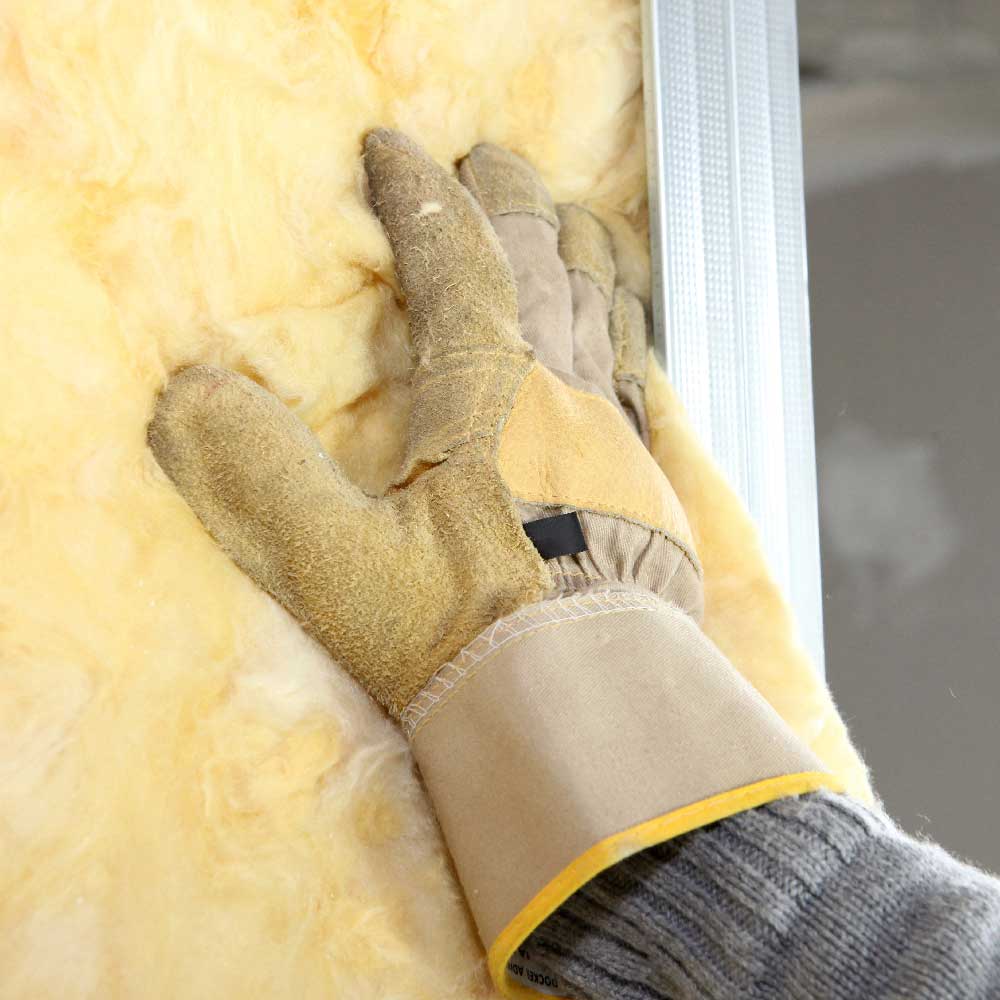
The exterior walls of a garage — the three sides facing the outside — are typically insulated with fiberglass batt and poly, the same product used in residential exterior walls. In a standard 2×4 framed garage wall, fiberglass batt delivers R-14 to R-15; a 2×6 wall achieves R-20 to R-22. The vapour barrier must be properly sealed at every electrical box and penetration — gaps in the poly are the most common source of cold air infiltration in garage walls.
Common Wall with the House — Roxul (Rockwool) Batt
The wall shared between an attached garage and the house is one of the most important insulation zones in any attached garage — and the one most often done wrong. Alberta Building Code requires fire separation between the garage and living space, and Roxul mineral fibre batt is the right product here: it’s non-combustible, will not melt or drip in a fire, and provides significantly better fire resistance than fiberglass. It also provides better sound control between the garage and adjacent rooms. If a contractor quotes fiberglass batt on your garage-to-house common wall, ask why.
Garage Ceiling — Roxul Batt or Closed Cell Spray Foam
If your garage has living space above it — a bonus room, bedroom, or home office — the garage ceiling is both a thermal boundary and a fire separation assembly. The right product depends on the depth of the floor assembly and the target R-value. Roxul batt is the standard choice for most applications; closed cell spray foam is specified where depth is limited or where the floor assembly has specific moisture exposure concerns. Either way, this ceiling needs to be treated as seriously as any other exterior assembly in your home.
If there’s no living space above and the garage ceiling is simply a roof assembly, insulating it depends on whether you want to heat the garage. If you do, insulating the ceiling is essential for retaining heat. If the garage will remain unheated, insulating the ceiling is less critical — but insulating the floor assembly of any room above the garage always is.
Rim Joists & Band Joists — Open Cell Spray Foam
Rim joists — the framing members at the perimeter of each floor level — are one of the most significant air leakage points in any attached garage. The irregular shape and multiple penetrations make them nearly impossible to insulate effectively with batt products. Open cell spray foam fills every void, creates an airtight seal, and is fast to install. If your garage has a room above, the rim joists of that floor are a priority.
Detached Garages Used as Workshops or Hobby Spaces
A truly detached garage — one with no shared walls or ceiling with the house — is worth insulating if you plan to heat it for use as a workshop, gym, or hobby space. Without insulation, the cost of heating a detached garage in an Alberta winter is prohibitive; with a properly insulated envelope, a modest heater keeps the space functional at a fraction of the energy cost. The insulation approach is similar to an attached garage exterior wall: fiberglass batt and poly on all walls, insulation on the ceiling if it’s a heated space. If it’s purely a vehicle storage garage and you have no plans to heat or use it, full insulation is less critical — our estimator will give you an honest assessment.
Is Your Garage Costing You More Than It Should?
Garage insulation problems show up in specific, recognisable ways — and most Alberta homeowners have experienced at least one of them. If any of these sound familiar, it’s worth getting an assessment:
Garage Insulation — What to Expect
Assessment & Quoting
Our estimator will assess your garage in detail before quoting — looking at the framing, existing insulation condition, vapour barrier, the garage’s relationship to the house (attached vs. detached, what’s above the ceiling), and any moisture or structural concerns. For new construction, we can work from plans for early-stage budgeting or complete a site measure once framing is done.
You’ll receive a written quote that specifies the product for each zone, the R-values being targeted, and the total price. No vague scope, no surprises on the invoice.
Installation Process
Most standard garage insulation projects — exterior walls and ceiling of a double attached garage — are completed in a single day. More complex projects involving multiple products, spray foam, or significant rim joist work may take longer. We’ll give you a clear timeline when we quote.
WE DON’T HAVE TO TELL YOU HOW GOOD WE ARE, OUR CUSTOMERS DO THAT FOR US.
“Our bonus room above the garage was unusable in January — just brutally cold no matter how high we turned the heat. IDEAL came out, found the garage ceiling had essentially no insulation and the rim joists were completely open. They did the Roxul on the ceiling, spray foam on the rim joists, and sealed the common wall properly. The room is now the same temperature as the rest of the house. Should have done it years ago.”
Tim & Rachel H.
Google Review — Garage Ceiling & Rim Joist Insulation, Calgary
“I converted my detached garage into a workshop and needed it properly insulated before winter. IDEAL quoted it the same day as the assessment, explained exactly what they were going to do and why, and had the crew out within a week. Walls and ceiling are done properly with fiberglass batt and poly. I can heat the space to a comfortable working temperature in about 20 minutes even on a cold day. Excellent work.”
Frank D.
Google Review — Detached Garage / Workshop Insulation, Edmonton
“IDEAL insulated the attached garage on our new build — exterior walls, common wall with Roxul, and the ceiling below the bonus room. They coordinated directly with our framer and were on site the day the framing was ready. Clean, fast, and exactly what was spec’d. The drywall trade had no complaints, which is always the sign of a good insulation job.”
Cynthia R., Builder
Google Review — New Construction Garage Insulation, Calgary
Garage Insulation — Frequently Asked Questions
It depends on how you use it. If it’s purely for vehicle storage and you have no plans to heat or work in it, full insulation is less critical — though insulating shared walls and any floor assemblies above it still makes sense. If you use it as a workshop, gym, hobby space, or any heated environment, insulating it properly is essential. Without an insulated envelope, heating a detached Alberta garage in winter is prohibitively expensive and largely ineffective. Our estimator will give you an honest assessment based on your specific situation.
The wall between an attached garage and your living space has fire separation requirements under the Alberta Building Code. We specify Roxul (Rockwool) mineral fibre batt for this wall — it’s non-combustible, will not melt or drip in a fire, and provides better fire resistance than fiberglass. It also provides superior sound control between the garage and adjacent rooms. If a contractor is quoting only fiberglass batt on your garage-to-house common wall, ask them about fire separation code compliance.
This is one of the most common garage insulation complaints we hear in Calgary and Edmonton. The most likely causes are: inadequate or missing insulation in the garage ceiling (the floor assembly of the room above), uninsulated rim joists at the perimeter of the floor, a compromised or unsealed vapour barrier, or cold air infiltration through the common wall. Our estimator will identify the specific cause during the assessment — in most cases, it’s a combination of two or three of these factors, not just one.
For most garage applications — exterior walls, common wall with house, ceiling — fiberglass batt or Roxul is the right product. Spray foam is specifically recommended for rim joists and band joists, where the irregular shape makes it nearly impossible to achieve a proper seal with batt products. Closed cell spray foam is also sometimes specified for garage ceilings below shallow floor assemblies where achieving target R-values requires the higher R-per-inch of foam. We’ll recommend spray foam only where it’s genuinely the better product, not as a default upsell.
Yes, significantly. An insulated garage maintains a much higher temperature than an uninsulated one on cold Alberta nights — often the difference between −25°C and −5°C. That temperature difference is critical for water supply lines and is usually enough to prevent freezing without active pipe heating. If pipes have already frozen and caused damage, that work needs to be completed before insulation is installed.
Garage door insulation is a separate product category from structural garage insulation — it involves adding rigid foam or reflective insulation panels to the door panels themselves. IDEAL focuses on structural insulation (walls, ceiling, common wall, rim joists) rather than door insulation. If you’re asking about the garage door specifically, a garage door company is the right call; we’re the right call for everything else.
The cost depends on the size of the garage, the products specified for each zone, and whether any existing insulation needs removal first. A standard double attached garage with exterior walls and ceiling runs significantly less than a fully remediated project involving spray foam, Roxul, and rim joist work. The best way to get an accurate number is a free on-site assessment — our estimator will measure the space, identify what’s needed in each zone, and give you a written quote with no obligation.
Yes. We have crews and offices in both cities and have been insulating garages across both markets for over 44 years. Whether you’re in the inner city, a new suburb, or a surrounding community, we can assess and quote your project.